The Drop-in Proxy Pattern for LLM Governance: Architecture, Compatibility, and Failure Modes
Why direct LLM integration breaks at the first audit, how a transparent governance proxy actually works, and the design constraints that decide whether the pattern scales.
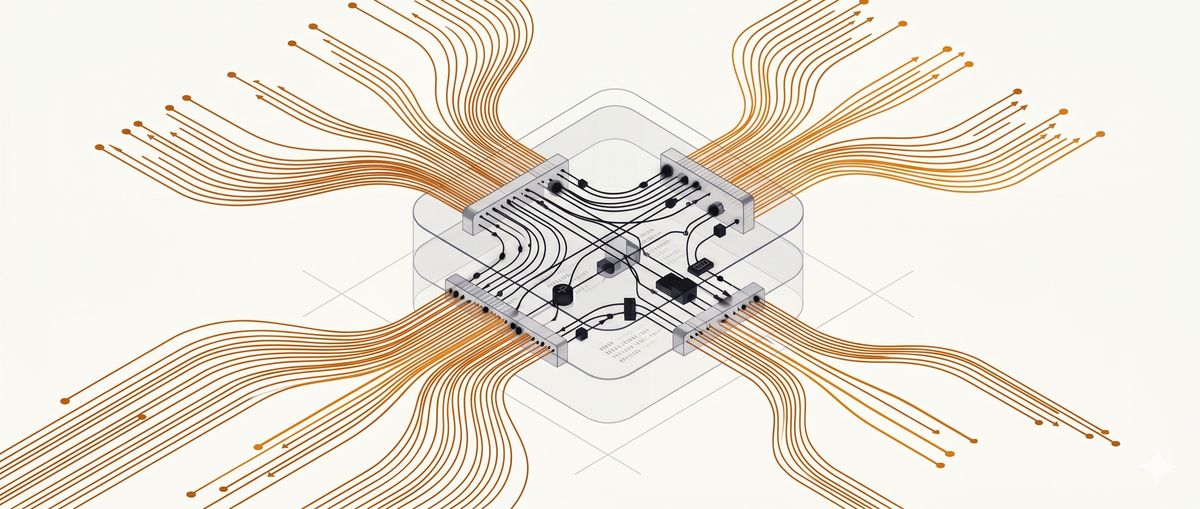
TL;DR. The hardest part of LLM governance isn't the policy engine. It's getting between the application and the provider without breaking anything. This post explains the transparent proxy pattern that scales, why API protocol compatibility is the design constraint that decides everything else, how streaming changes the enforcement window, and the production failure modes that don't appear in the architecture diagram.
Contents
- Why direct LLM integration breaks at the first audit
- The transparent governance proxy pattern
- API compatibility is the design constraint
- Streaming and the enforcement window
- Where policy actually runs
- The audit trail every regulator now asks for
- Production lessons and trade-offs
- When this pattern is wrong for you
1. Why direct LLM integration breaks at the first audit
Most enterprises have rolled out LLM access the way they roll out any new SaaS API: each team grabs an API key, integrates the provider's SDK directly into their application, and ships. This works exactly until the first audit, the first PII incident, or the first security review of an AI-adjacent system. Then someone in compliance asks four questions, and no one in engineering has the answers:
- Which prompts have left our network in the past quarter, and what did they contain?
- How do we ensure customer data, credentials, and intellectual property never end up in a third-party provider's training pipeline or log?
- If a model returns confidential information that should not have been visible, is there a control that prevents the response from reaching the user?
- What policy applied to a given LLM call, who approved it, and can you reproduce that decision deterministically?
The teams that integrated directly cannot answer these questions, because the integration is the gap. The provider sees the prompt before any internal control runs, and the response arrives at the application before any internal validation. Logging at the application layer captures whatever the developer remembered to log, which is usually not what the auditor needs.
The pattern that solves this without rewriting every application is a transparent governance proxy that sits between the application and the provider, speaks the provider's own protocol, and applies policy in flight. The rest of this article is about how that pattern actually works in production.
2. The transparent governance proxy pattern
The architecture is straightforward to draw and surprisingly subtle to build:
- Auth handover
- Pre-stream policy
- In-stream chunk inspection
- Audit emit
The application keeps using its existing SDK. No imports change. No client library gets replaced. The only configuration that changes is the base URL: instead of pointing at the vendor's public endpoint, it points at the proxy. The proxy speaks the same wire protocol the SDK expects, applies policy on the way through, and forwards (or blocks) the request.
Conceptually this resembles an enterprise web proxy or an API gateway. Two things make LLM governance harder than plain HTTP filtering. A prompt carries intent, not just a payload, so the proxy has to reason about request semantics. And responses stream over many seconds, which breaks the clean request/response model most policy engines assume.
3. API compatibility is the design constraint
The reason most "AI security platform" rollouts stall is that they require teams to refactor their applications to talk to a proprietary governance API. From the engineering organization's point of view this is a non-starter: every application that uses an LLM has to be re-tested, re-deployed, and re-validated. Multiplied across an enterprise, that is a multi-quarter project before any policy actually enforces anything.
Here is the constraint that decides whether the pattern scales: the proxy has to speak each provider's wire protocol exactly. The same routes and headers, the same authentication scheme, response shapes and error semantics that match down to the byte, the same sequence of streaming events. An application should not be able to tell whether it is talking to the real provider or to the proxy.
Practically, this means a single base URL change is all that's required:
Before: direct integration
# Application talks directly to the upstream provider
export LLM_API_BASE="https://api.upstream-provider.example.com"
export LLM_API_KEY="sk-***"

curl "$LLM_API_BASE/v1/messages" \
  -H "Authorization: Bearer $LLM_API_KEY" \
  -H "Content-Type: application/json" \
  -d '{
    "model": "anthropic-3-class-large",
    "messages": [{"role": "user", "content": "Summarize Q3 results."}]
}'After: through the governance proxy
# Same request, only the base URL changed
export LLM_API_BASE="https://governance.internal.example.org"
export LLM_API_KEY="sk-***"   # unchanged

curl "$LLM_API_BASE/v1/messages" \
  -H "Authorization: Bearer $LLM_API_KEY" \
  -H "Content-Type: application/json" \
  -d '{
    "model": "anthropic-3-class-large",
    "messages": [{"role": "user", "content": "Summarize Q3 results."}]
}'The application code does not change. The SDK does not need to know the proxy exists. The provider's request format is preserved end-to-end. What changes is what happens between the two requests on the wire.
A worthwhile test before you build anything: if your governance layer needs application changes beyond a base-URL switch (and, optionally, a CA certificate trust update), the rollout will stall on the engineering organization, not on the policy team. Prove that compatibility constraint first.
4. Streaming and the enforcement window
Most modern LLM endpoints support Server-Sent Events (SSE) streaming. The client opens an HTTP connection, the server holds it open, and tokens arrive as named events over many seconds. This is what makes LLM applications feel responsive, and it is also what makes naive policy enforcement impossible.
The traditional API gateway model assumes: receive the full request, decide, forward, receive the full response, decide, return. Streaming breaks both halves of that. A request body can be received in full at the start (so policy on the prompt is straightforward), but the response arrives token by token over a connection that may stay open for 30 seconds or more. By the time you have seen the whole response, the user has already seen most of it.
The enforcement window therefore has two distinct phases. Pre-stream, before the request is forwarded to the provider, the proxy has the full prompt available and can run any blocking policy. In-stream, while the response is being delivered, the proxy buffers and inspects each chunk before forwarding it to the client. If a chunk contains content that violates a policy, the proxy can rewrite it, redact it, or terminate the stream entirely.
The wire-level pattern looks like this:
Two design notes. In-stream chunk inspection is bounded by latency: any per-chunk work has to finish within milliseconds, or it wrecks the streaming experience the architecture exists to protect. And the proxy does more than inspect the stream; it authors the SSE stream the client receives. So it can inject its own events (a synthetic policy event ahead of the first content_delta, say) to signal decisions to clients built to read them.
5. Where policy actually runs
A useful mental model: the proxy has three policy decision points, and each one has different trade-offs.
- Pre-stream. Before anything is forwarded, the proxy has the full prompt, system message, model parameters, and caller identity in hand, so it can block, require approval, or allow with redaction. The latency budget here is generous, since the user is waiting for a response regardless.
- In-stream. Now the proxy sees one chunk at a time against accumulating context, and can redact, rewrite, or terminate the stream. The budget is tight: per-chunk work must not stall delivery.
- Post-stream. With the full response and complete audit context available, the proxy can emit audit records, open incidents retroactively, or run evaluations. This work is asynchronous, decoupled from user-visible latency.
A common mistake is to put everything at pre-stream because it is the easiest enforcement point to reason about. The result is a proxy that catches obvious leaks in prompts but misses everything that the model itself produces. The opposite mistake, putting everything in-stream, is even worse, because it makes the proxy the single point of latency for every LLM interaction in the organization.
The split that holds up in production is easy to state: block at pre-stream, modify content in-stream, and keep audit and retroactive analysis at post-stream. The policy engine is identical across all three stages; what changes is what it is permitted to do.
6. The audit trail every regulator now asks for
Once the proxy is in place, the audit trail is almost a free byproduct, but only if you design it correctly from the start. The properties that matter to regulators (and to your future self when you are reconstructing an incident eight months later):
- Every LLM interaction becomes a single audit record, rather than a request log in one place and a response log in another.
- Events are append-only: written once and never updated, with no edit operation anywhere in the schema.
- Each event carries a hash of its predecessor, so any after-the-fact change breaks the chain detectably.
- The record captures which policy version applied, what it decided, and which human, if any, approved an exception.
- From a single record you can reconstruct the original decision deterministically, blocked requests included, and those carry the most weight as compliance evidence.
The schema sketch:
{
  "event_id": "01HF7K3M5N8Q2R9V0W3X4Y5Z6A",
  "ts": "2026-05-06T12:14:08.331Z",
  "tenant": "tenant-a",
  "actor": {
    "principal": "service-account/data-platform",
    "ip_redacted": "10.x.x.x"
  },
  "request": {
    "endpoint": "/v1/messages",
    "model": "anthropic-3-class-large",
    "input_hash": "sha256:e3b0c4...",
    "input_redacted_preview": "Summarize [PII_REDACTED] results."
  },
  "policy": {
    "bundle_version": "v2026.05.04-r3",
    "decision": "allow_with_redaction",
    "matched_rules": ["pii.financial.summary"]
  },
  "response": {
    "output_hash": "sha256:7d865e...",
    "redactions_applied": 2,
    "duration_ms": 3417
  },
  "previous_event_hash": "sha256:6f9b1a...",
  "event_hash": "sha256:a4c8d2..."
}The pairing of previous_event_hash and event_hash is the chain that makes the trail tamper-evident. A nightly integrity check walks it forward from a known-good anchor, and any break opens an automatic incident. That gives an external auditor a claim they can actually reason about: the logs cannot be quietly altered without the chain showing it.
7. Production lessons and trade-offs
A few things you only learn after you have run this pattern in production for a while.
Latency is not free
Every stage of policy enforcement adds milliseconds. For pre-stream policy, the user experience absorbs this. The round trip to a hosted LLM is already measured in seconds. For in-stream chunk inspection, every millisecond of per-chunk processing translates to slower-feeling responses. Profile and budget aggressively. The temptation to add "one more check" per chunk is the single most common cause of "the proxy made our app slow" complaints.
Fail-closed is the only correct default
If the PII scanner is unreachable, the request must be blocked. If the policy bundle cannot be loaded, the request must be blocked. If the audit sink is down, the request must be blocked (or, at minimum, the response must be buffered until audit is available). Fail-open looks more user-friendly until the day a scanner outage coincides with the prompt that should have been the most important to block.
Policy authoring is a separate problem
The proxy enforces policy. It does not decide what policy to enforce. Treat policy as code: version-controlled, reviewed by two independent approvers, signed, and deployed through the same pipeline that owns any other production change. A policy engine without governance over the policy authors is theatre.
Multi-tenancy raises the bar on isolation
If the proxy serves more than one organizational unit, the audit chain, the policy bundle, and the redaction tokens all have to be tenant-scoped. A row-level filter is not enough: you want schema-level isolation backed by row-level enforcement, so that even an honest mistake in a query cannot read across tenant boundaries.
8. When this pattern is wrong for you
The transparent proxy pattern is the right answer for the largest class of LLM governance problems, but it is not the right answer for all of them. A few cases where you should look for a different approach:
- Agentic workflows that orchestrate many tools. An agent that talks to ten tools across several providers needs governance at the agent layer, not at each individual provider call. The proxy is necessary here but not sufficient.
- Browser-based AI usage. If your users are pasting into a vendor's web UI, no API-level proxy will see those interactions. You need a different control surface, typically session-level instrumentation or browser policy.
- Private model deployments inside your perimeter. When the model never leaves your network, the data-leakage problem changes shape; a transparent proxy still helps with governance and audit, but there is no longer a confidentiality problem for it to solve.
- Hard real-time use cases. If your application has sub-100ms latency requirements, in-stream policy enforcement is fundamentally at odds with your design. Pre-stream and post-stream may still work; in-stream usually does not.
Knowing when not to apply the pattern is part of applying it well. The teams that get the most value out of a governance proxy are the ones who treat it as one layer in a defense-in-depth architecture, not as the single answer to every AI risk question.
Ready to secure your
enterprise infrastructure?
Schedule a technical briefing. No sales pitch — just architects and your team.